D Blevins
asked on September 5, 2025
Work-energy theorem application
What is the work-energy theorem and how do you apply it?
Need Help?
Hire one of our expert Physics tutor online. 24/7 Service. Available now.
Expert Answer
Answered on October 28, 2025 by EXPERT TUTOR
Nothing Found
Dear D Blevins,
The work-energy theorem states that the net work done on an object equals the change in its kinetic energy. According to expert tutors at My Physics Buddy, this single relationship connects force, displacement, and motion in one powerful equation. It is one of the most versatile tools in all of Physics.
Understanding and Applying the Work-Energy Theorem
At its core, the work-energy theorem tells you that if you push on something and it moves, that push changes how fast the object is going. More precisely, it says:
Wnet = ΔKE = KEf − KEi = ½mvf² − ½mvi²
Where:
- Wnet = total net work done on the object (Joules, J)
- m = mass of the object (kilograms, kg)
- vf = final speed (metres per second, m/s)
- vi = initial speed (metres per second, m/s)
- ΔKE = change in kinetic energy (Joules, J)
Work done by a single constant force is defined as:
W = Fd cos θ
Where F is the magnitude of the force (N), d is the displacement (m), and θ is the angle between the force vector and the direction of motion. When the force and motion point in the same direction, θ = 0° and cos θ = 1, so W = Fd. When they are perpendicular (like a normal force on a horizontal surface), cos 90° = 0 and no work is done at all.
The Everyday Analogy
Think about pushing a shopping trolley from rest. Every metre you push it forward, you are transferring energy into the trolley, speeding it up. The harder you push and the farther you push, the faster it gets. The work-energy theorem puts precise numbers to exactly that intuition. Friction acts in the opposite direction, doing negative work and slowing the trolley down. The net work is what ultimately determines the change in speed.
Why Net Work Matters
A mistake I see constantly in my teaching is students forgetting the word net. You must add up the work done by every force acting on the object — gravity, friction, applied forces, normal forces — before setting it equal to ΔKE. Forces perpendicular to motion contribute zero work, which simplifies things nicely.
Worked Example — Step by Step
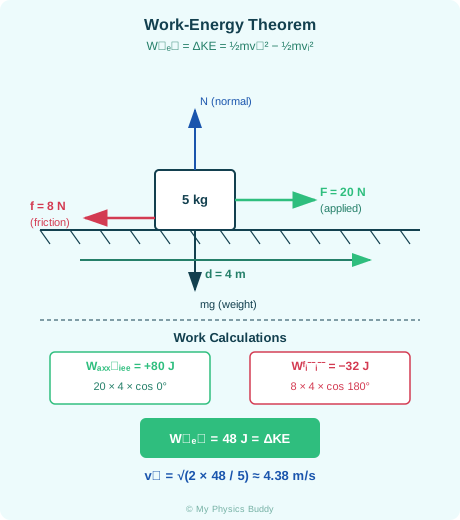
Problem: A 5 kg box starts from rest on a flat surface. A horizontal applied force of 20 N pushes it over a distance of 4 m. Friction exerts a constant opposing force of 8 N. What is the box’s speed at the end?
Step 1 — Work done by the applied force:
Wapplied = Fapplied × d × cos 0° = 20 × 4 × 1 = 80 J
Step 2 — Work done by friction:
Wfriction = Ffriction × d × cos 180° = 8 × 4 × (−1) = −32 J
Step 3 — Net work:
Wnet = 80 + (−32) = 48 J
Step 4 — Apply the work-energy theorem:
Wnet = ½mvf² − ½mvi²
48 = ½ × 5 × vf² − 0
vf² = 48 × 2 / 5 = 19.2 m²/s²
vf = √19.2 ≈ 4.38 m/s
Notice how elegantly this bypasses Newton’s second law and kinematics entirely. You did not need to calculate acceleration or use v² = u² + 2as separately — though you would get the same answer if you did. As a PhD-trained physicist, I find this one of the most satisfying shortcuts in all of Classical (Newtonian) Mechanics.
The diagram below summarises this worked example visually, showing the forces, directions, and energy change in one clear picture.
For a deeper mathematical treatment of how work relates to energy and force fields, the LibreTexts University Physics — Work and Kinetic Energy chapter is an excellent and freely accessible reference.
It is also worth noting that the work-energy theorem applies even when the force varies over the displacement. In that case, work becomes the integral of force over distance: W = ∫F·dx. This is the version you will encounter in AP Physics C: Mechanics and university-level courses.
Common Mistakes to Avoid
✗ Mistake: Using only one force (like the applied force) to calculate work and setting it equal to ΔKE.
✓ Fix: Always calculate the work done by every individual force, sum them algebraically to get Wnet, and then apply the theorem.✗ Mistake: Forgetting that the angle θ is between the force vector and the displacement vector, not the angle of an incline or some other geometric angle in the diagram.
✓ Fix: Always draw the force and displacement vectors explicitly and measure θ directly between them before computing cos θ.✗ Mistake: Treating the work-energy theorem as a vector equation and trying to give Wnet a direction.
✓ Fix: Work and kinetic energy are scalars. Wnet is a signed number (positive or negative), not a vector. A negative Wnet simply means the object slows down.
Exam Relevance: The work-energy theorem is a core topic in AP Physics 1, IB Physics HL/SL, A/AS Level Physics (9702), and IGCSE Physics (0625). It appears in multiple-choice, short-answer, and extended-response questions across all these curricula.
Pro Tip from Sriram S: When a problem involves forces at angles on a curved or multi-segment path, the work-energy theorem is almost always faster than applying Newton’s second law at every point.
Related Questions
How to answer 9702 Paper 5 planning questions effectively?
How does electromagnetic induction work and what is Faraday’s law?
What is the difference between nuclear fission and fusion in A Level?
How to calculate specific heat capacity from experimental data?
What is simple harmonic motion and how to derive its equations?
How to solve problems involving circular motion and centripetal force?
What are the common mistakes in 9702 Paper 2 structured questions?
How to interpret and draw electric field line diagrams?