R Reese
asked on March 1, 2026
AP Physics 1 exam topics overview
What topics are covered on the AP Physics 1 exam?
Need Help?
Hire one of our expert Physics tutor online. 24/7 Service. Available now.
Expert Answer
Answered on March 3, 2026 by EXPERT TUTOR
Nothing Found
Dear R Reese,
The AP Physics 1 exam topics span seven core areas: kinematics, forces and Newton’s laws, energy, momentum, rotation, oscillations, and electric charge and circuits. According to expert tutors at My Physics Buddy, the exam tests both conceptual reasoning and quantitative problem-solving. Mastering each unit builds the foundation you need for the full course.
A Complete Breakdown of AP Physics 1 Exam Topics
The AP Physics 1 exam is algebra-based, meaning you do not need calculus — but you do need a strong command of physical reasoning and mathematical relationships. The College Board organizes the course into seven units, each carrying a specific exam weighting. Think of the course like building a house: kinematics and forces form the foundation, energy and momentum are the walls, and rotation, oscillations, and circuits are the roof that ties everything together.
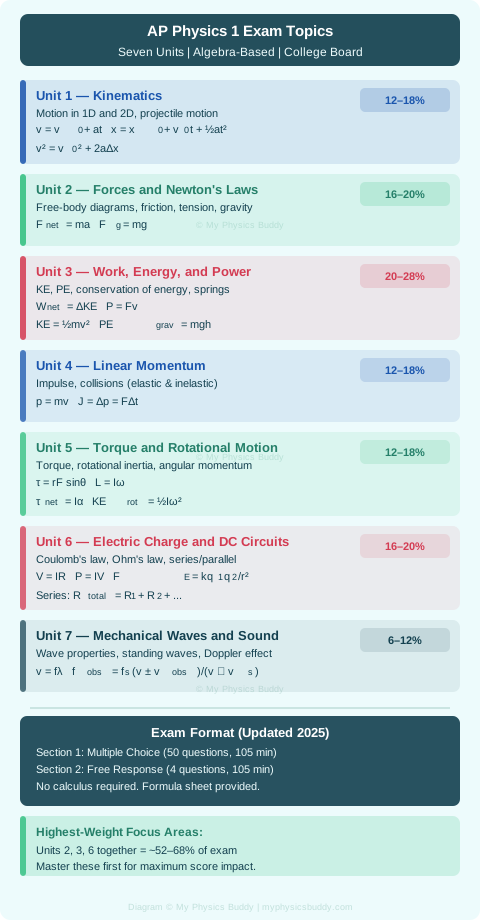
Here is a clear overview of every unit tested on the exam, along with its approximate weighting in the multiple-choice and free-response sections:
| Unit | Topic | Exam Weight |
|---|---|---|
| 1 | Kinematics | 12–18% |
| 2 | Forces and Newton’s Laws of Motion | 16–20% |
| 3 | Work, Energy, and Power | 20–28% |
| 4 | Linear Momentum | 12–18% |
| 5 | Torque and Rotational Motion | 12–18% |
| 6 | Electric Charge, Force, and Energy; DC Circuits | 16–20% |
| 7 | Mechanical Waves and Sound | 6–12% (if tested) |
Note: The College Board revised the AP Physics 1 curriculum starting in 2025. Fluids and some oscillation content have been moved to AP Physics 2. Always confirm the current exam description directly on the College Board AP Physics 1 page.
Unit 1 — Kinematics
This unit covers motion in one and two dimensions. You will work with displacement, velocity, and acceleration using the kinematic equations. Projectile motion is a key two-dimensional application. The core equations are:
- v = v₀ + at — final velocity, where v₀ is initial velocity, a is acceleration, t is time
- x = x₀ + v₀t + ½at² — position as a function of time
- v² = v₀² + 2aΔx — velocity-displacement relationship
Unit 2 — Forces and Newton’s Laws
Newton’s three laws underpin nearly every mechanics problem. Drawing a free-body diagram before writing equations is non-negotiable. Friction, tension, normal force, and gravity all appear here. Newton’s second law, Fnet = ma, is the engine of this unit.
Unit 3 — Work, Energy, and Power
Energy is arguably the single highest-weight topic on the exam. The work-energy theorem connects net work to change in kinetic energy: Wnet = ΔKE. Conservation of energy problems — where you track kinetic energy, gravitational potential energy, and spring potential energy — are extremely common. Power is defined as P = W/t or equivalently P = Fv.
Unit 4 — Linear Momentum
Impulse-momentum theorem and conservation of momentum govern collisions. Both elastic and inelastic collisions appear. A useful intuition: momentum is harder to change when mass is large or velocity is high — like trying to stop a freight train versus a bicycle.
Unit 5 — Torque and Rotational Motion
This is where many students feel challenged. Torque is the rotational analogue of force: τ = rF sin θ, where r is the lever arm, F is the applied force, and θ is the angle between them. Rotational inertia, angular momentum, and rolling motion all appear. As a PhD physicist, I can tell you that the rotational-linear analogy (swap m for I, v for ω, F for τ) is one of the most powerful tools in physics.
Unit 6 — Electric Charge, Force, and Circuits
Coulomb’s law governs electrostatic force, and basic DC circuit analysis using Ohm’s law (V = IR) and power (P = IV) is tested here. Series and parallel resistor combinations are essential skills. For deeper circuit work, see our guide on AP Physics topics.
Unit 7 — Mechanical Waves and Sound
Wave properties including frequency, wavelength, amplitude, and wave speed (v = fλ) are tested, along with standing waves and the Doppler effect.
One pattern I consistently see in students: they study each unit in isolation and then struggle on free-response questions that blend two or three topics — for example, a rolling object problem that requires both energy conservation and rotational dynamics simultaneously. Practice cross-unit problems deliberately.
Common Mistakes to Avoid
✗ Mistake: Ignoring exam unit weightings and spending equal time on every topic.
✓ Fix: Prioritize Units 2, 3, and 6 — they collectively account for over 50% of the exam. Allocate study time proportionally to exam weight.✗ Mistake: Confusing mass and weight, or treating g as a force rather than an acceleration.
✓ Fix: Always write gravitational force as Fg = mg explicitly. Mass (kg) and weight (N) are different quantities with different units.✗ Mistake: Skipping free-body diagrams on force and torque problems to save time.
✓ Fix: Draw the free-body diagram first, every time. It takes 30 seconds and prevents sign errors that cost you the entire problem.
Exam Relevance: These topics are tested on the AP Physics 1 exam administered by the College Board, and overlap significantly with content in IB Physics SL, the SAT Physics Subject Test (retired), and introductory college physics courses.
💡 Pro Tip from Vandna G: Map each practice problem you attempt to its unit and track your accuracy per unit. Your weakest unit by score deserves double the review time.
Related Questions
How to calculate the speed of a wave on a string?
What are standing waves and how do harmonics work?
How to explain physics concepts qualitatively for AP Physics 1 FRQs?
What is the best way to review for AP Physics 1 in two weeks?
How to apply Newton’s second law in rotational form?
How does energy transfer work in simple harmonic motion?
How to solve problems with pulleys and tension in AP Physics 1?
What is mechanical energy and when is it conserved?