G Richardson
asked on February 3, 2025
Why objects fall at same rate
Why do heavier and lighter objects fall at the same rate?
Need Help?
Hire one of our expert Physics tutor online. 24/7 Service. Available now.
Expert Answer
Answered on February 4, 2025 by EXPERT TUTOR
Nothing Found
Dear G Richardson,
Heavier and lighter objects fall at the same rate because gravitational acceleration acts equally on all masses, regardless of how heavy they are. The extra gravitational pull on a heavier object is exactly cancelled by its greater resistance to acceleration — its inertia. According to expert tutors at My Physics Buddy, this elegant cancellation is one of the most beautiful results in all of Physics.
Why Mass Cancels Out: The Deep Physics of Free Fall
G Richardson, this question gets right to the heart of Classical (Newtonian) Mechanics — and it confused brilliant minds for centuries before Galileo and Newton sorted it out. Let me walk you through exactly why this happens, because once you see it, you will never forget it.
The Two Types of Mass
The key insight lives in a subtle but crucial distinction between two concepts that both carry the word “mass”:
- Gravitational mass (mg) — this determines how strongly gravity pulls on an object. Think of it as the object’s “gravitational charge.” A heavier object has more gravitational mass, so Earth pulls on it with a bigger force.
- Inertial mass (mi) — this determines how strongly an object resists being accelerated. A heavier object requires more force to get moving — or to speed up during a fall.
Here is the remarkable fact: experimentally and theoretically, gravitational mass and inertial mass are always exactly equal. This equivalence is so fundamental that Einstein later elevated it to a cornerstone principle called the Equivalence Principle, which underpins General Relativity.
The Mathematical Proof
Let’s make this completely explicit with Newton’s Second Law and Newton’s Law of Gravitation.
Newton’s Second Law tells us:
F = mi × a
where F is the net force (in Newtons, N), mi is inertial mass (in kg), and a is acceleration (in m/s²).
Newton’s Law of Gravitation near Earth’s surface gives the gravitational force as:
Fg = mg × g
where mg is gravitational mass (in kg) and g is the gravitational field strength of Earth, approximately 9.8 m/s².
Setting these equal (since gravity is the only force in free fall, ignoring air resistance):
mi × a = mg × g
Since mi = mg for every object, they cancel perfectly:
a = g = 9.8 m/s²
The mass disappears entirely from the equation. Every object — a feather, a bowling ball, a planet — accelerates at exactly the same rate in a pure gravitational field, regardless of mass. That is the complete answer in four lines of algebra.
An Everyday Analogy
Imagine you are trying to push two shopping trolleys — one empty and one fully loaded. The loaded one is harder to push (more inertia), but if you apply a proportionally bigger push to the loaded trolley, both trolleys accelerate at the same rate. Gravity does exactly this automatically: it applies a bigger pull to the heavier object in precise proportion to how hard that object is to accelerate. The result is identical acceleration every time.
A Worked Numerical Example
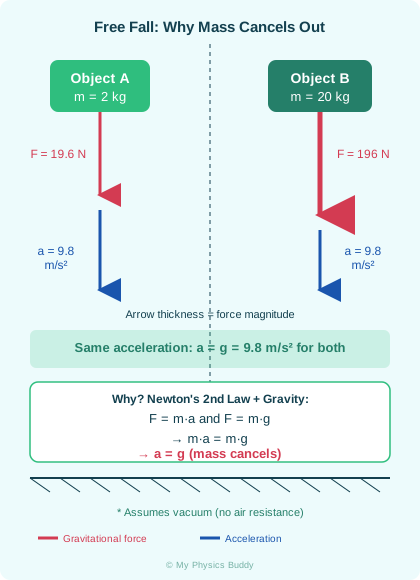
Let’s confirm this with two objects: Object A (mass = 2 kg) and Object B (mass = 20 kg), both dropped from rest in a vacuum.
| Object | Mass (kg) | Gravitational Force F = mg (N) | Acceleration a = F/m (m/s²) |
|---|---|---|---|
| Object A | 2 kg | 2 × 9.8 = 19.6 N | 19.6 ÷ 2 = 9.8 m/s² |
| Object B | 20 kg | 20 × 9.8 = 196 N | 196 ÷ 20 = 9.8 m/s² |
Object B experiences ten times the gravitational force — but it also has ten times the inertia. The ratio is always 1:1. Acceleration is identical for both.
What About Air Resistance?
In real life, air resistance complicates things. A feather falls more slowly than a hammer because air resistance is large relative to the feather’s weight. In a vacuum, they fall together — famously demonstrated on the Moon by Apollo 15 astronaut David Scott in 1971, who dropped a hammer and a feather simultaneously. You can watch the footage at NASA’s Apollo 15 Feather Drop archive. When we say heavier and lighter objects fall at the same rate, we mean in the absence of air resistance — this is the standard assumption in most physics problems.
As a PhD physicist, I can tell you that the equivalence of gravitational and inertial mass is one of the most precisely tested facts in all of science. Experiments by Stanford’s STEP project have confirmed this equivalence to better than one part in 1012. It is not merely a convenient approximation — it is exact, as far as we can measure.
In teaching this over the years, I have noticed that students who struggle most are those who only remember “g is the same for all objects” without understanding why. The why is the mass cancellation — and once that clicks, the whole picture becomes clear.
Common Mistakes
✗ Mistake: Thinking a heavier object experiences the same gravitational force as a lighter one.
✓ Fix: A heavier object experiences a proportionally larger gravitational force — but its larger inertia cancels this out exactly, giving the same acceleration.✗ Mistake: Confusing free fall in a vacuum with falling through air, and concluding that objects always fall at different rates.
✓ Fix: State clearly that equal fall rates apply only when air resistance is negligible or absent. Always specify your assumptions in exam answers.✗ Mistake: Writing a = F/m and then substituting different values of F for different masses without recognising that F itself scales with m.
✓ Fix: Substitute F = mg into a = F/m as a single step — a = mg/m = g — to make the cancellation explicit and avoid arithmetic errors.
Exam Relevance: This topic appears in GCSE Physics, IGCSE Physics (0625), AP Physics 1, and IB Physics HL/SL, typically in units covering forces, gravity, and Newton’s laws. Exam questions often ask students to explain the reasoning, not just state the result.
Pro Tip from Dr. Vipul S: In any exam answer, always write out a = mg/m = g explicitly — showing the cancellation step earns you the reasoning marks every time.
Related Questions
How to calculate the speed of a wave on a string?
What are standing waves and how do harmonics work?
How to explain physics concepts qualitatively for AP Physics 1 FRQs?
What is the best way to review for AP Physics 1 in two weeks?
How to apply Newton’s second law in rotational form?
How does energy transfer work in simple harmonic motion?
How to solve problems with pulleys and tension in AP Physics 1?
What is mechanical energy and when is it conserved?