L Al-Enezi
asked on August 24, 2025
Why free fall causes weightlessness
Why does an object in free fall experience weightlessness?
Need Help?
Hire one of our expert Physics tutor online. 24/7 Service. Available now.
Expert Answer
Answered on September 23, 2025 by EXPERT TUTOR
Nothing Found
Dear L Al-Enezi,
An object in free fall experiences weightlessness because the only force acting on it is gravity, and every part of it accelerates at exactly the same rate. There is no contact force pushing upward through the object, so the internal compression that normally creates the sensation of weight simply vanishes. According to expert tutors at My Physics Buddy, this is one of the most elegantly counterintuitive results in Physics.
Understanding Weightlessness in Free Fall: The Deep Physics
Let’s start by being precise about what “weight” actually means in a physics context, L, because this is where most confusion begins. In everyday language, people use “weight” to mean how heavy something feels. In physics, we define two distinct ideas:
- Gravitational weight (W): The gravitational force exerted on a mass m by a planet, given by W = mg, where g is the local gravitational field strength (≈ 9.81 m s⁻² near Earth’s surface).
- Apparent weight: The contact or normal force that a surface exerts on you — the force you actually feel. This is what a scale reads.
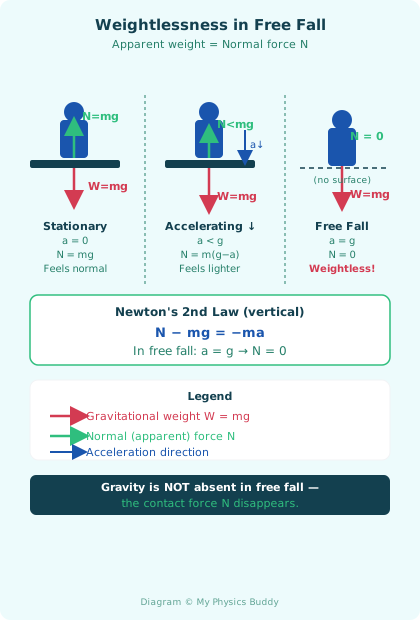
Weightlessness during free fall refers to the disappearance of apparent weight, not gravitational weight. Gravity is absolutely still present and pulling the object downward — this point is critical and we will return to it.
The Normal Force is the Key
Imagine you are standing on a scale inside a lift (elevator). The scale reads your apparent weight because it pushes upward against the soles of your feet with a normal force N. Newton’s second law along the vertical direction gives:
N − mg = ma
where:
- N = normal (contact) force from the scale on you (N)
- m = your mass (kg)
- g = gravitational field strength ≈ 9.81 m s⁻² (taking downward as negative, upward as positive)
- a = acceleration of the system (m s⁻²)
Now consider three scenarios:
| Scenario | Acceleration | Normal Force N | What You Feel |
|---|---|---|---|
| Stationary or constant velocity | a = 0 | N = mg | Normal weight |
| Accelerating downward at a < g | a downward | N = m(g − a) | Lighter than normal |
| Free fall (a = g downward) | a = g | N = m(g − g) = 0 | Completely weightless |
When a = g, the normal force drops to exactly zero. The scale would read nothing. Your body has no surface pressing against it, so no part of you is being compressed or stretched by contact forces. That is the physical origin of the weightless sensation.
An Everyday Analogy: The Lift with a Cut Cable
Imagine you are holding a book on your palm inside a lift. Your palm pushes up on the book and the book pushes down on your palm — that push is what you feel as the book’s weight. Now suppose the cable snaps and the entire lift goes into free fall. Both you and the book accelerate downward at exactly g. The book no longer needs your palm to support it — it falls at the same rate as your hand. The contact force between them disappears completely. You could remove your hand and the book would stay right there, floating beside you. This is precisely what astronauts experience aboard the International Space Station, which is essentially in continuous free fall around Earth.
The Einstein Connection: Equivalence Principle
As a PhD Physicist, I find it deeply satisfying to point out that this idea sits at the very heart of Einstein’s General Relativity. Einstein’s equivalence principle states that being in free fall in a gravitational field is locally indistinguishable from being in a region of space with no gravity at all. Free fall is the natural, unforced state of motion in a gravitational field — it is standing still on the ground that requires a force (the ground pushing up on you). This perspective completely reframes how we think about gravity.
For a deeper look at how these ideas extend into orbital mechanics, explore Classical (Newtonian) Mechanics and see how satellites maintain continuous free fall. You can also read more about how NASA describes the free-fall environment aboard the ISS at NASA’s official microgravity resource.
Why Gravity Has Not Disappeared
One of the most persistent mistakes I see in my tutoring sessions is students concluding that “there is no gravity in space” because astronauts float. At the ISS altitude of about 400 km, gravitational field strength g is still approximately 8.7 m s⁻² — over 88% of its surface value. The astronauts float not because gravity is absent but because the station and everyone inside it are all falling together at the same rate. The cause of weightlessness is the absence of a supporting contact force, never the absence of gravity itself.
Common Mistakes
✗ Mistake: Stating that “there is no gravity in free fall” or “gravity switches off in space.”
✓ Fix: Gravity is still fully present. Weightlessness means the apparent weight (normal force) is zero because there is no supporting surface — gravitational force on the object is unchanged.✗ Mistake: Confusing gravitational weight (W = mg) with apparent weight and using them interchangeably in equations.
✓ Fix: Always identify whether a question asks for gravitational force or the reading on a scale. Apply Newton’s second law carefully: N = m(g − a) for a downward-accelerating system.✗ Mistake: Thinking weightlessness only occurs when an object is stationary far from Earth.
✓ Fix: Weightlessness occurs whenever the only force acting is gravity and there is no contact force — this includes a ball thrown upward at any point in its trajectory, a skydiver before the parachute opens, and any orbiting satellite.
Exam Relevance: This topic appears in IGCSE Physics (0625), IB Physics HL/SL, A/AS Level Physics (9702), and AP Physics 1, typically within forces, Newton’s laws, and gravitational fields units.
Pro Tip from Raminder G: Whenever a free-fall question appears, immediately write N = m(g − a) and substitute a = g — the answer follows in one clean line.
Related Questions
How to analyze motion graphs for AP Physics?
What is the difference between static and kinetic friction in AP Physics?
How to handle unit conversions in AP Physics problems?
What are the FRQ scoring guidelines for AP Physics?
How to solve impulse and momentum problems on the AP exam?
What is the best AP Physics prep book for self-study?
How to approach experimental design questions on AP Physics?
How do you calculate the moment of inertia for different shapes?