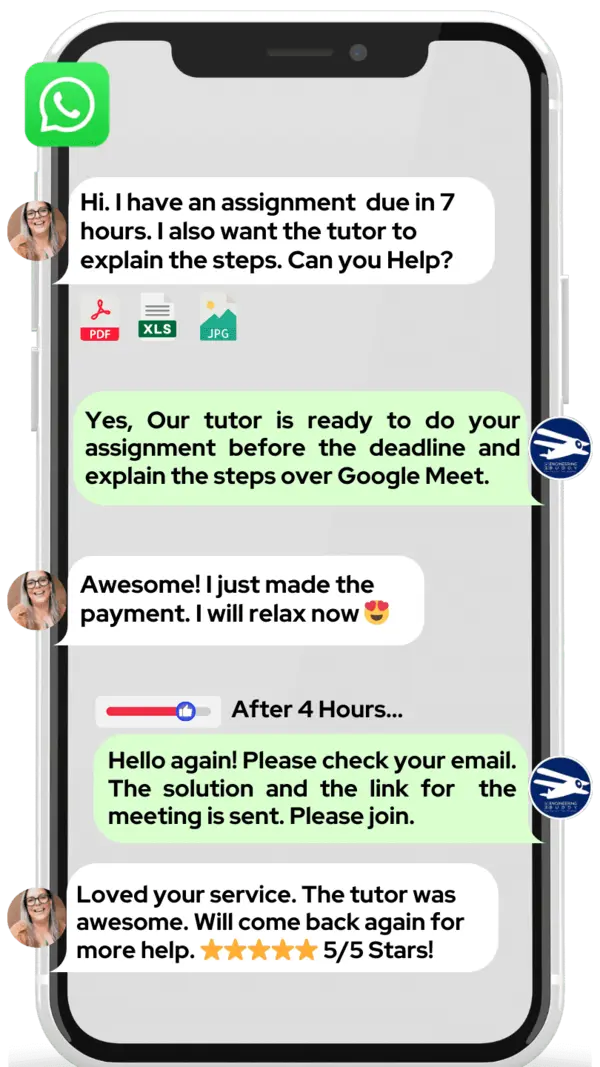
Hire Best AP Physics Tutors Online



Testimonials



AP Physics Tutor Online
My Physics Buddy (MPB) offers 1:1 online tutoring & homework help in Physics and related subjects. If you are preparing for AP Physics 1, AP Physics 2, AP Physics C: Mechanics, or AP Physics C: Electricity and Magnetism, MPB connects you with a subject-specialist tutor for live, personalized sessions. Whether you are an early college student, a high school student gearing up for the exam, or a parent looking for reliable online AP Physics support, MPB is built for you. Searching for an AP Physics tutor near me? Our fully online format means location is never a barrier. Sessions are designed to help you aim for a strong AP score and build real conceptual depth along the way.
- 1:1 live sessions — no group classes, no recordings to watch alone
- Tutors matched by AP course, topic strength, and your learning pace
- Flexible scheduling across US, UK, Canada, Australia, and Gulf time zones
- Structured learning plan built after a diagnostic session
- Ethical homework and assignment guidance — we explain concepts, you submit your own work
Who This AP Physics Tutoring Is For
MPB’s AP Physics program is designed for a specific set of learners across multiple regions and academic levels.
- High school and early college students in the US taking AP Physics 1, 2, or C and aiming for a score of 4 or 5
- Students in the UK, Canada, or Australia enrolled in equivalent advanced physics programs who are supplementing their studies
- Students in the Gulf region (UAE, Saudi Arabia, Qatar, etc.) studying an American curriculum at international schools
- Parents of AP students who want structured, accountable weekly support for their child
- Students who missed key foundational topics (kinematics, forces, circuits) and need targeted catch-up
- Students needing guided help understanding homework problems, lab report structure, or free-response question technique
Outcomes: What You’ll Be Able To Do in AP Physics
Tutoring at MPB is outcome-oriented. By the end of a focused engagement, most students notice real shifts in how they approach problems and exams. These are not guarantees — they are the kinds of capabilities that consistent, well-guided practice tends to build.
Solve multi-step problems in mechanics and electromagnetism without relying on formula memorization alone. Analyze motion, forces, energy, and circuits using both algebra and calculus-based approaches (depending on your AP course). Model physical scenarios with free-body diagrams, circuit schematics, and vector decomposition. Explain your reasoning clearly in free-response questions, using the structured format AP examiners expect. Apply conservation laws, Newton’s laws, and field theory to unfamiliar exam scenarios with confidence.
What We Cover in AP Physics (Syllabus / Topics)
AP Physics is offered in four distinct courses by College Board. Coverage at MPB follows each course’s official domain structure. Exact question formats and weightings vary by exam year — always verify current details with College Board directly.
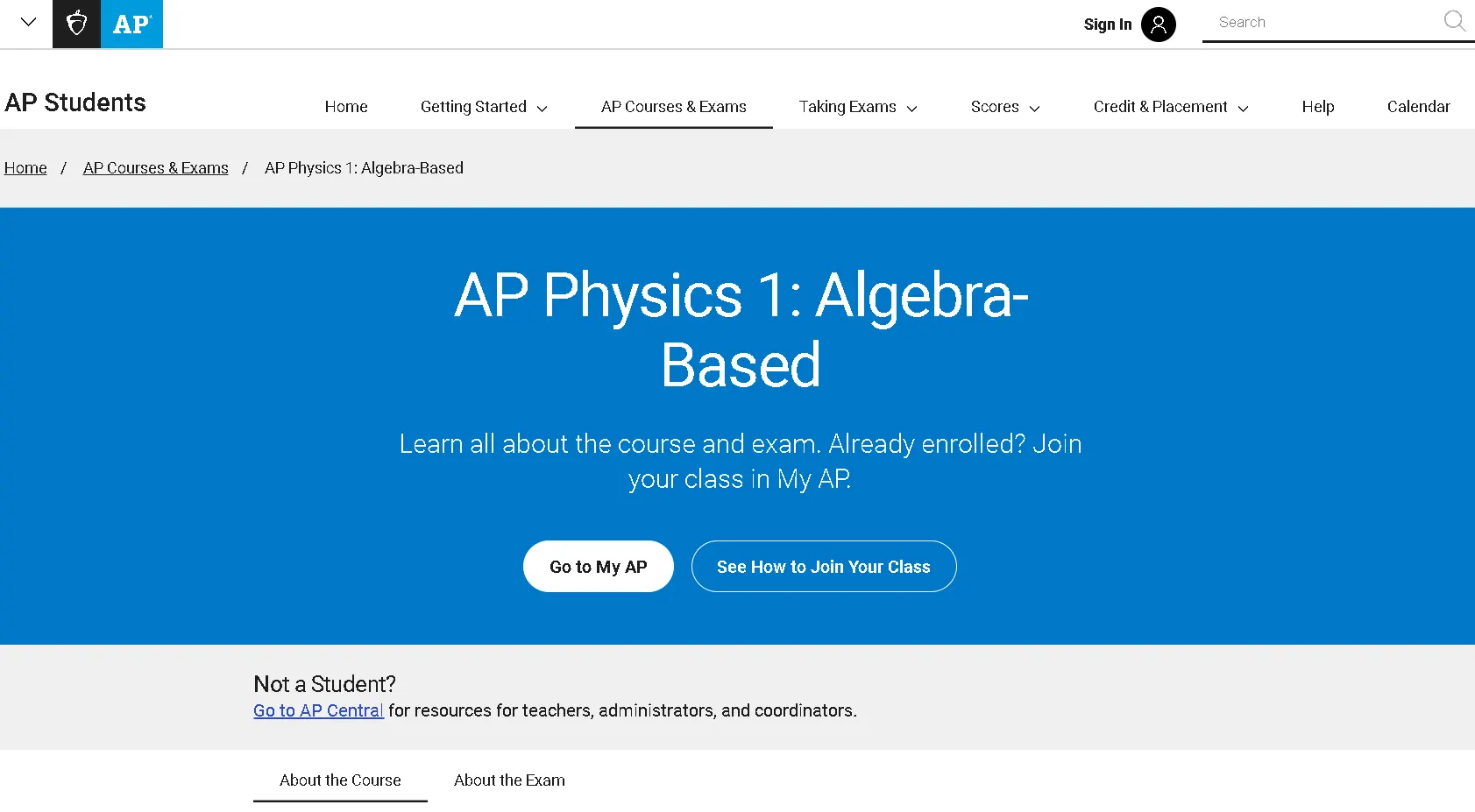
Explore AP Physics 1, an algebra-based introductory physics course covering motion, forces, energy, and real-world applications.
AP Physics 1: Algebra-Based
- Kinematics: 1D and 2D motion, projectile motion
- Newton’s Laws: forces, friction, tension, circular motion
- Energy: work, kinetic energy, potential energy, conservation laws
- Momentum: impulse, collisions, center of mass
- Rotational motion: torque, angular momentum, moment of inertia
- Oscillations: simple harmonic motion, period, frequency
- Waves and sound: wave properties, standing waves, resonance
- Electric charge and simple DC circuits: Ohm’s law, series and parallel
- Free-response and experimental design questions
AP Physics 2: Algebra-Based
- Fluid mechanics: pressure, buoyancy, Bernoulli’s principle
- Thermodynamics: gas laws, heat engines, entropy at a conceptual level
- Electrostatics: electric fields, Coulomb’s law, electric potential
- Capacitors and DC circuits: multi-loop analysis, RC circuits
- Magnetism and electromagnetic induction: Faraday’s law, Lenz’s law
- Geometric and physical optics: lenses, mirrors, interference, diffraction
- Modern physics: photoelectric effect, atomic models, nuclear decay
- Free-response argumentation and paragraph-style answers
AP Physics C: Mechanics (Calculus-Based)
- Kinematics using derivatives and integrals
- Newton’s Laws applied with calculus: variable forces, integration of equations of motion
- Work, energy, and power: calculus-based derivations
- Systems of particles and linear momentum
- Rotation: angular kinematics, torque, rotational dynamics, rolling motion
- Oscillations: SHM derivations, energy in oscillating systems
- Gravitation: gravitational potential energy, orbital mechanics
AP Physics C: Electricity and Magnetism (Calculus-Based)
- Electrostatics: Gauss’s law, electric potential via integration
- Conductors, capacitors, and dielectrics
- Electric circuits: Kirchhoff’s laws, RC transients using differential equations
- Magnetic fields: Ampere’s law, Biot-Savart law
- Electromagnetic induction: Faraday’s law, Lenz’s law, inductors
- Maxwell’s equations at an introductory level
- Free-response multi-part derivations and graph interpretation
Students working across related physics topics can also explore Electromagnetism, Waves and Optics, and Kinematics tutoring pages on MPB for deeper coverage of those specific domains.
How My Physics Buddy Tutors Help You with AP Physics (The Learning Loop)
Diagnose: Every engagement starts with a diagnostic. The tutor identifies which AP topics are strong, which are shaky, and where your exam technique breaks down. This shapes every session that follows.
Explain: Tutors don’t re-read the textbook to you. They find the angle that clicks — whether that’s a visual, an analogy, a worked example, or a first-principles derivation — and adapt until the concept lands.
Practice: You work through AP-style problems live during the session: multiple-choice questions, free-response questions, and experimental design prompts. The tutor watches your process, not just your answer.
Feedback: After each problem set, you get specific, actionable feedback. “Your setup was correct but you dropped the sign in the torque calculation” is more useful than “review Chapter 8.”
Retest / Reinforce: Weak topics come back in later sessions in new problem contexts. Retention is built through spaced repetition, not one-time coverage.
Plan: The tutor adjusts the session plan based on your score trajectory, upcoming exam date, and confidence level. You always know what the next session will focus on.
Accountability: For students on weekly plans, tutors check in on progress between sessions and help you stay on track with your study schedule.
Sessions run live on Google Meet with a digital pen-pad or iPad + Pencil for equation work and diagram annotation. It feels close to a whiteboard session, but recorded steps can be revisited. Before your first session, it helps to share your syllabus (AP course and any school-specific pacing guide), your weakest topics, and your exam date. The first session typically includes a short diagnostic problem set, a live teaching segment on one key topic, and a clear plan for the next two to four sessions.
AP Physics C exams are consistently ranked among the most challenging AP exams by subject difficulty. According to College Board’s score distributions, mean scores and 5-rate figures vary significantly year to year across all four AP Physics courses. Understanding where you stand before the exam — and adjusting your preparation accordingly — is one of the highest-leverage moves a student can make.
Tutor Match Criteria (How We Pick Your Tutor)
MPB matches you to a tutor based on several factors, not just subject name. Here is what goes into the decision:
Level and exam board fit: Your tutor will have direct experience with the specific AP Physics course you are taking — AP Physics 1, 2, C: Mechanics, or C: E&M — including its free-response format and scoring rubric style.
Topic strengths: If your weak area is electromagnetic induction or rotational dynamics, we match you with a tutor whose strength aligns with that domain.
Tools and setup: All MPB tutors use Google Meet for live sessions and a digital pen-pad or iPad + Pencil for real-time equation and diagram work — essential for a subject like AP Physics.
Time zone and availability: Tutors are available across US, UK, Canada, Australia, and Gulf time zones. Sessions are scheduled to fit your school week.
Learning style and pace: Some students want fast, high-volume practice. Others need careful concept-building before they touch problems. Your tutor adapts to your mode.
Language and communication preferences: Clear, accessible English-language instruction is the default. Communication style is matched to your comfort level.
Goals: Whether your goal is a score of 5, passing the exam, clearing up homework confusion, or building a foundation for college physics, the tutor approach differs. We align on goals before sessions start.
Urgency and timeline: A student with six weeks to exam day gets a different plan than one starting in September for a May exam. Tutor selection factors in your remaining timeline.
Study Plans (Pick One That Matches Your Goal)
MPB offers three broad plan types: a short catch-up plan (typically one to two weeks) for students who need to close specific gaps fast, an exam prep plan (typically four to eight weeks) for structured AP exam preparation, and an ongoing weekly support plan for students who want consistent help throughout the school year. The tutor builds the specific session-by-session plan after the diagnostic — there is no fixed schedule until your starting point and goals are clear.
Pricing Guide
AP Physics tutoring at MPB starts at USD 20 per hour and typically ranges up to USD 40 per hour for most AP-level courses. For highly advanced topics or specialized AP Physics C content requiring calculus expertise, rates may go higher — up to USD 100 per hour in some cases.
Pricing depends on the specific AP course (Physics 1 vs. C: E&M), the tutor’s level and experience, your timeline (shorter prep timelines may affect availability and cost), and session frequency. Rates are discussed transparently before you commit to any plan.
Pricing is not one-size-fits-all. A student who needs weekly concept support throughout the year has different needs — and a different cost structure — than one doing intensive exam prep in the final four weeks. MPB matches pricing to the actual scope of support, not a blanket package.
FAQ
Is AP Physics hard?
AP Physics is considered one of the more demanding AP subjects, particularly the calculus-based C courses. Difficulty depends heavily on your math foundation and prior physics exposure. According to College Board research data, pass rates and score distributions vary across the four AP Physics courses. With consistent, well-guided preparation, the material is learnable at any skill level.
How many sessions are needed?
This depends on your starting point, your exam date, and your goal score. Students doing targeted gap-filling may need four to six sessions. Students on a full exam prep track typically benefit from twelve to twenty sessions over six to eight weeks. Your tutor will give a clearer estimate after the diagnostic session.
Can you help with AP Physics homework or assignments?
Yes — as guided support, not submission. Your tutor will walk through problem-solving strategies, explain the physics behind confusing questions, and help you understand where your approach went wrong. MPB does not complete or submit assignments for students. All materials and guidance provided are for learning and reference purposes only. Academic integrity is non-negotiable.
Does the tutoring exactly match my school’s AP Physics syllabus?
MPB follows the official AP Physics course framework published by College Board, which all accredited AP courses are aligned to. If your school uses a specific pacing guide or textbook, share it before your first session and the tutor will incorporate it. Exact topic sequencing varies by school and teacher.
What happens in the first session?
The first session typically includes a short diagnostic to identify your current level, a live teaching segment on one high-priority topic, and a discussion of your goals and timeline. Come prepared with your AP course name, your weakest topics, any recent tests or quizzes, and your exam date. The session runs on Google Meet.
Is online tutoring as effective as in-person?
For a structured subject like AP Physics, online tutoring with digital pen-pad tools can be highly effective. Live problem-solving, diagram annotation, and real-time feedback replicate most of what happens in an in-person session. Multiple studies on online STEM learning, including work published by EDUCAUSE, suggest that one-on-one online instruction compares favorably to face-to-face formats when the tools and tutor quality are strong.
Do I need calculus for AP Physics?
For AP Physics 1 and 2, no — both are algebra-based. For AP Physics C: Mechanics and AP Physics C: Electricity and Magnetism, yes — calculus is used throughout. Derivatives, integrals, and differential equations appear regularly. If your calculus is weak, your tutor can address both simultaneously, though it will affect the pacing of sessions.
Can you help with AP Physics lab reports?
Yes, as structural and conceptual guidance. AP Physics labs involve data analysis, error estimation, and scientific argumentation. Your tutor can help you understand what a well-written lab report looks like, how to interpret your data, and how to structure your conclusion. MPB does not write lab reports for students.
What tools does the tutor use during sessions?
All sessions run on Google Meet. Tutors use a digital pen-pad or iPad with Apple Pencil to write equations, draw free-body diagrams, and annotate circuit schematics in real time. Some tutors also use shared Google Docs or whiteboards for working through multi-step problems. No special software is required on your end beyond a browser and stable internet.
Can graduate students or university students use MPB for physics support?
Yes. While AP Physics is a high school-level exam, MPB serves early college students, graduate students, and postgraduate learners across all levels of physics. Students studying related areas such as Classical (Newtonian) Mechanics, Electrodynamics, or Thermodynamics at university level are also welcome.
Trust & Quality at My Physics Buddy
Tutor selection: MPB tutors hold degrees in Physics, Engineering Physics, or closely related quantitative fields — many at the postgraduate level. Every tutor goes through a subject screening, a live demo session, and an ongoing feedback process tied to student outcomes. Tutors are not generalists; they are matched to the specific AP Physics course and topic domain you need.
Academic integrity: MPB’s position is clear. We guide, you submit your own work. Tutors explain concepts, work through similar examples, and provide feedback on your reasoning. They do not write solutions for students to copy. This protects your academic record and ensures that learning actually occurs. All guidance is framed as explanation, structured feedback, and conceptual clarification.
About MPB: My Physics Buddy is a Physics-focused online tutoring platform serving early college students, graduate students, and advanced learners across the US, UK, Canada, Australia, and Gulf regions. Our core is Physics and closely related quantitative subjects. Students preparing for other Physics exams or exploring specialized topics can browse related pages including AP Physics (overview), AP Physics C: Mechanics, AP Physics C: Electricity and Magnetism, and broader Physics tutoring.
Research on physics education consistently points to conceptual understanding — not formula recall — as the key differentiator for high-performing students. A 2022 study published in the Physics Education Research community found that students who received regular formative feedback during problem-solving showed measurably stronger conceptual retention compared to those relying on passive review. MPB’s learning loop is built on this principle.
“The goal of physics education is not to produce physicists but to cultivate scientific thinking — the ability to take an unfamiliar situation, identify the relevant principles, and reason to a conclusion.”
— Carl Wieman, Nobel Laureate in Physics, Stanford University (Science, 2011)
AP Physics demands more than memorizing equations. The College Board’s AP Physics 1 exam, for example, now places significant weight on multi-step free-response questions that require students to construct arguments, interpret data, and connect multiple physics principles in a single answer. This shift rewards students who understand the “why,” not just the “what.” That is exactly what 1:1 tutoring is built to develop.
“One-on-one tutoring has been shown to produce results two standard deviations above classroom-only instruction — the so-called ‘2 sigma problem’ that educational researchers have spent decades trying to replicate at scale.”
— Benjamin Bloom, based on findings from Educational Researcher (1984)
Access millions of peer-reviewed articles and journals on Taylor & Francis Online, a leading academic research platform.
Students exploring related exam preparation on MPB may also find the pages on AP Physics 1: Algebra Based and AP Physics 2: Algebra Based useful for course-specific detail. For students interested in standardized exams beyond AP, MPB also supports preparation for GRE Physics and MCAT Physics.
Content reviewed by an AP Physics tutor at My Physics Buddy.
Next Steps
Tell us your AP Physics course (1, 2, C: Mechanics, or C: E&M), your current level, your exam date, and your main challenge areas. We will match you with a tutor whose background fits your course and timeline. Scheduling is flexible across all primary time zones. Most students are matched and into their first session within a few days of reaching out.